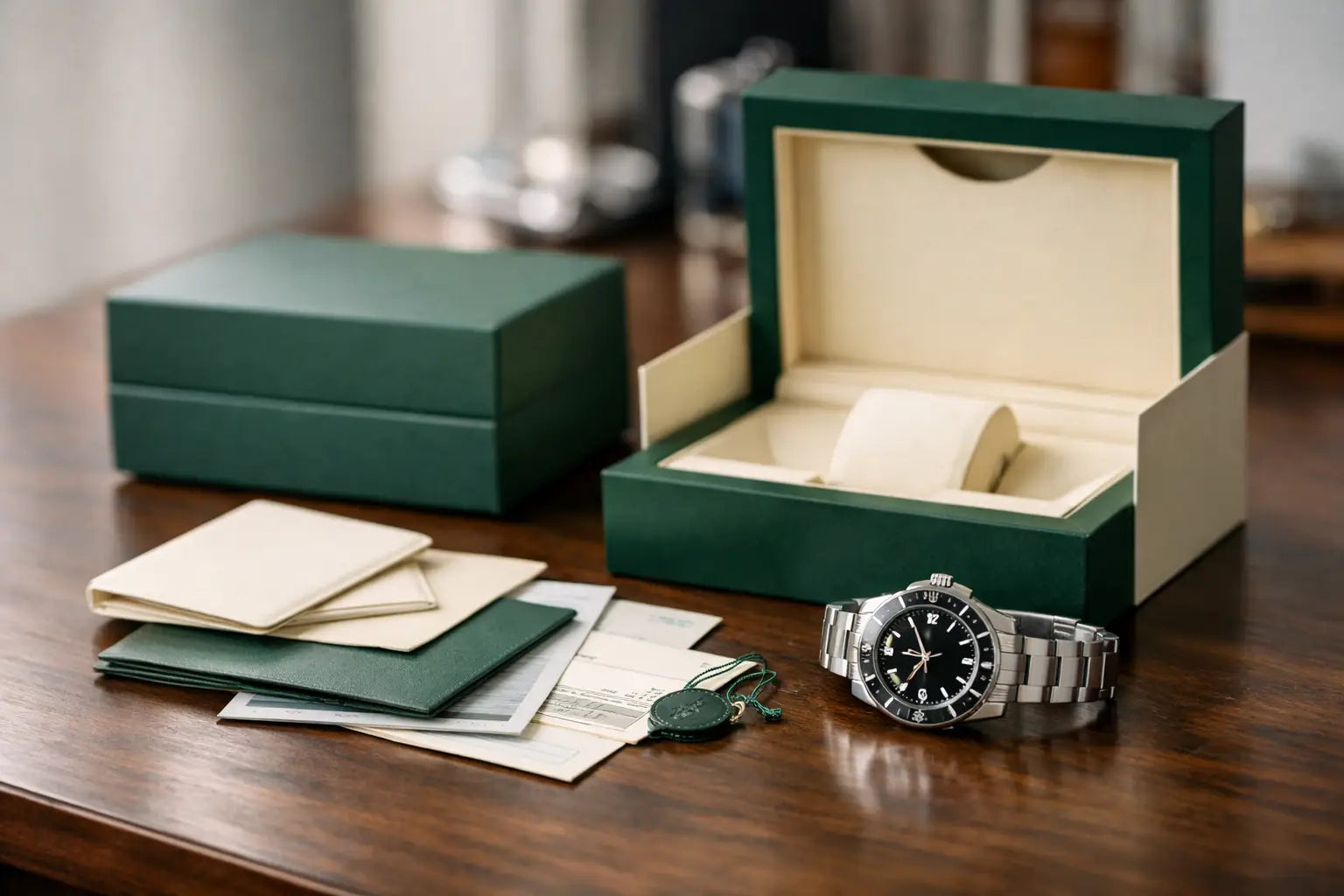
Someone offers you less for your watch because the warranty card is missing, and suddenly the question becomes very real: do box and papers matter? In the pre-owned watch market, they do matter - but not in a simple, fixed way. The impact depends on the brand, model, age, rarity and the type of buyer you are selling to.
If you are selling a modern Rolex, Omega, Tudor or Patek Philippe, missing accessories can affect both value and sale speed. If you are selling a vintage watch from the 1960s or 1970s, the absence of the original box may be far less important than the condition of the dial, case and movement. The key point is this: box and papers can strengthen a watch sale, but they are not the watch itself.
Do box and papers matter for value?
Yes, in most cases they add value. They also add confidence, which in practice can be just as important.
A complete set usually means the watch comes with its original presentation box, warranty card or papers, booklets, swing tags, spare links and sometimes original purchase receipt. Not every item carries the same weight. The warranty card or original papers are generally the most commercially important because they help confirm provenance and can make a buyer more comfortable about authenticity, ownership history and marketability.
For many current-production luxury watches, a full set can command a noticeable premium over a watch-only example. It can also attract stronger offers more quickly. Buyers know that if they purchase a complete watch today, it will often be easier to resell later.
That said, the premium is not universal. A standard modern watch in average condition will not suddenly become highly desirable just because the outer box is present. Likewise, a rare or heavily sought-after reference can still sell very well without accessories if the watch itself is right.
Which matters more - the box or the papers?
The papers matter more.
If you only have one of the two, original papers usually carry greater value than the box. That is because papers can help establish when and where the watch was first sold, and they support the watch's backstory in a way a box alone cannot. From a buyer's point of view, that reduces friction.
The box still has value, especially for newer luxury models where collectors expect completeness. It improves presentation and can make a watch feel better cared for. But commercially, the box is often the secondary piece.
There are exceptions. Some vintage boxes are collectible in their own right, and for certain top-end pieces the original full presentation set can be a meaningful part of the package. Still, if you are deciding what to prioritise when searching drawers and cupboards, start with the papers.
Why box and papers matter to buyers
Pre-owned watch buyers are not paying only for metal and movement. They are paying for confidence.
A watch with box and papers often feels safer to buy. It suggests the watch has had a more traceable life. It can indicate the seller has owned it properly rather than picked it up through unclear channels. That does not mean a watch without accessories is suspicious by default, but it does mean the buyer may ask more questions.
There is also a practical resale angle. Dealers and private buyers both think ahead. If they buy a watch with its original accessories, they know they will likely have a broader audience when it comes time to sell. That future flexibility has a direct effect on what they are willing to pay now.
For gift buyers and collectors, completeness matters for emotional reasons too. The full set feels finished. It is closer to the original buying experience. On certain references, especially modern sports models from brands with strong collector demand, that matters.
When missing box and papers matters less
This is where nuance matters.
If the watch is vintage, original papers are often long gone. That is normal. A 40 or 50-year-old watch may still be highly desirable without them, provided the watch itself is correct and honest. In that part of the market, buyers focus more on originality of parts, dial condition, matching serials, service history and whether the case has been over-polished.
The same applies to lower-value watches where the cost of replacing missing accessories can seem disproportionate to the watch's market price. For a mainstream model worth a few hundred pounds, buyers may care less about a missing box than they would on a watch worth several thousand.
Inherited watches are another example. Executors and families often do not have the full set, especially if the original owner kept the watch for decades. That does not stop the watch from having real value. It simply means the valuation is based more heavily on the watch's condition, authenticity and current market demand.
How much value is lost without box and papers?
There is no single percentage that fits every watch.
On some modern luxury references, missing box and papers may reduce value modestly. On others, especially popular collector-led models, the gap can be more noticeable. The spread is driven by demand, how common full sets are in the market, and how sensitive buyers are to completeness for that specific model.
For example, a newer Rolex Submariner, GMT-Master II or Daytona without papers will usually be judged more harshly than an older, less hyped dress watch from a lower-demand brand. A recent Omega Speedmaster with its cards and presentation set is also likely to perform better than the same watch sold loose. Tudor Black Bay models, Cartier sports references and many Grand Seiko pieces can show a similar pattern.
But value loss is not always dramatic. If the watch is in excellent condition, has been serviced properly, and comes from a credible seller, it can still achieve a strong market-aligned price. Serious buyers assess the whole package, not just what comes around it.
Can you still get a good price without them?
Yes, absolutely.
A genuine watch from a desirable brand can still sell well without box and papers. What matters is how the watch is assessed and who is doing the buying. An experienced specialist buyer will not reject a strong watch simply because the extras are missing. They will look at authenticity, condition, service needs, polish history, bracelet stretch, dial and handset correctness, and current wholesale and retail demand.
This is one reason sellers often get frustrated with general marketplaces. Private buyers may focus too heavily on missing accessories while lacking the expertise to judge the watch properly. That can lead to low offers, drawn-out questions and unnecessary doubt.
A professional watch buyer approaches it differently. The valuation should reflect the real market for that watch as it stands, not a blanket penalty applied without context.
Should you replace a missing box or papers?
Usually, no.
Buying a replacement box rarely adds enough value to justify the cost unless it is the correct original set for that exact model and period. Generic or mismatched boxes can create more confusion than confidence. They may even raise questions during appraisal.
Replacing papers is usually not possible in the true original sense. Some brands may be able to confirm service records or issue service documentation after maintenance, but that is not the same as original point-of-sale paperwork.
If you do have supporting material, keep it together. A service invoice, original purchase receipt, valuation paperwork, old sales invoice or brand correspondence can all help support the watch's story even if the original papers are missing.
What to do if you are selling a watch with no box and papers
Be straightforward from the start. State clearly what is included and what is not. If you have spare links, service receipts or any ownership history, mention them. If the watch was inherited, say so. Clear information reduces delays and helps produce a firmer valuation.
Before selling, check drawers, loft boxes, safes and filing cabinets properly. Many owners assume the papers are gone when they are simply stored separately from the watch. Warranty cards and spare links are especially easy to misplace.
Then focus on the factors that still drive value. Clean presentation helps, but do not overdo it. Keep the watch in its current state unless advised otherwise. Gather any service documents. Take clear photographs of the dial, case, caseback, clasp, bracelet and serial area where appropriate.
If speed, security and a fair result matter, use a buyer who understands the difference between a watch-only piece that should trade strongly and one where missing accessories genuinely hold it back. That expertise matters more than generic assumptions.
Watch Nest sees this every day. Some sellers have immaculate full sets. Others have only the watch on the wrist and a service receipt from ten years ago. Both can be sold successfully when the valuation is based on real market knowledge rather than a scripted discount.
A missing box or papers should not stop you from exploring a sale. They may affect the number, but they do not define the watch. The strongest outcome comes from understanding what buyers value, what they do not, and getting your watch in front of someone who can tell the difference.