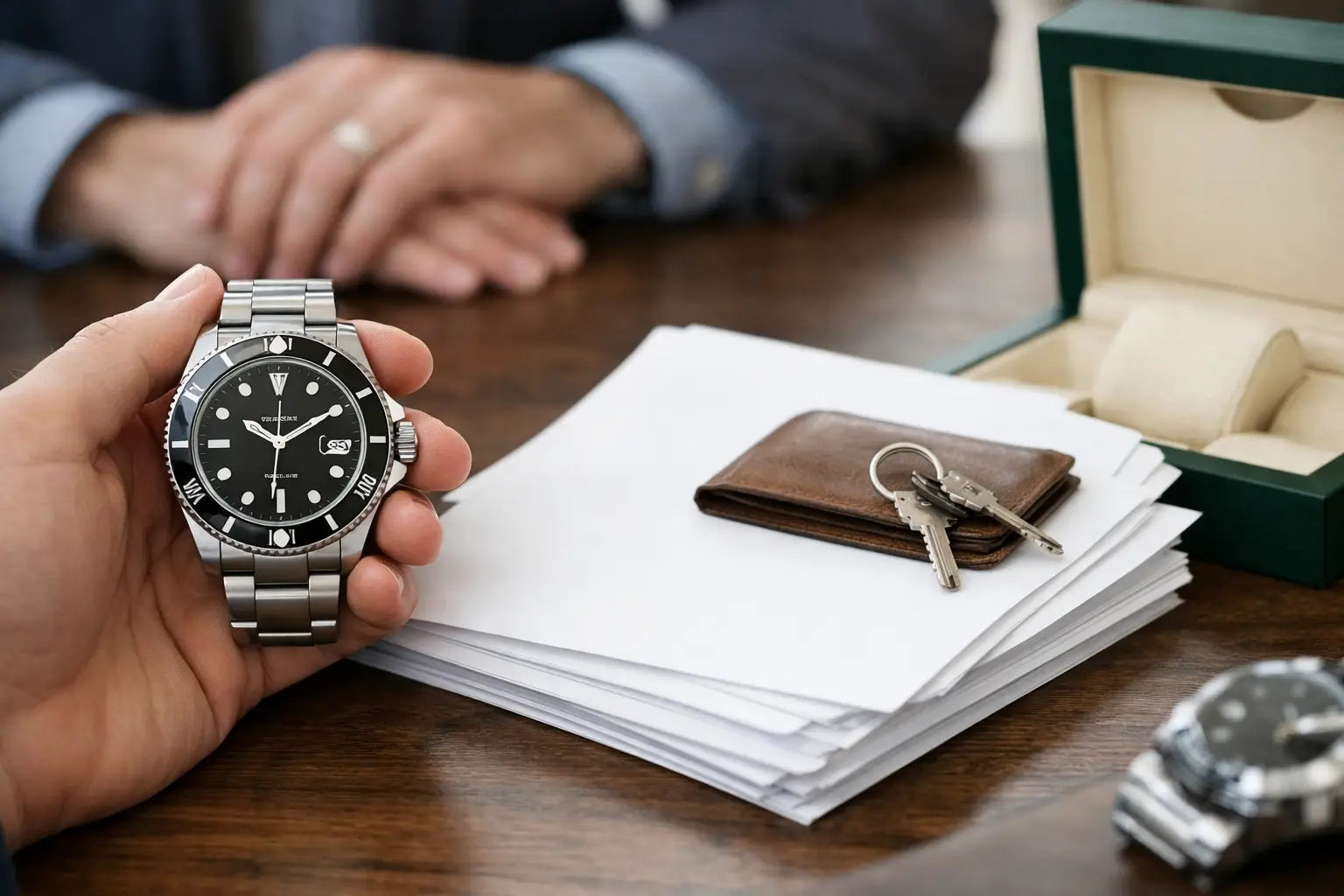
A missing warranty card does not make a Rolex unsellable. It does, however, change how the watch is assessed, how quickly a buyer can make a firm offer, and in some cases what price you should expect. If you want to sell Rolex without papers, the key is to deal with a serious buyer who knows how to verify authenticity, condition and market demand without relying on the original set.
For many sellers, the papers were lost years ago during a house move, left behind after an inheritance, or simply separated from the watch after servicing or storage. That is common across the pre-owned market, especially with older Datejust, Submariner, GMT-Master, Day-Date and Oyster Perpetual models. The real question is not whether the watch can be sold, but how to sell it properly and avoid unnecessary value loss.
Can you sell Rolex without papers in the UK?
Yes, absolutely. A Rolex can still be sold without its original warranty card, booklets, tags or box. Plenty of genuine watches change hands every day as watch-only pieces. This is particularly true with vintage references, older five-digit sports models and inherited watches where the original accessories have long since disappeared.
That said, papers do matter. They help confirm provenance, match serial and reference details, and make the watch easier to resell. For that reason, a complete set will usually command a stronger price than the same watch sold head only. How much that gap matters depends on the model, age, rarity and current market appetite.
A modern ceramic Daytona with full set paperwork is a different proposition from a 1980s Datejust that has been worn regularly for decades. In one case, missing papers may have a noticeable impact. In the other, the adjustment may be modest if the watch itself is clean, correct and clearly authentic.
What buyers check when papers are missing
When papers are absent, the buyer has to lean more heavily on the watch itself. That is where experience matters. A specialist buyer will inspect the case, dial, bracelet, clasp, movement and serial markings to establish whether the watch is genuine, original and commercially desirable.
Condition is usually the first major pricing factor. A sharp case, original dial, strong bracelet and clean movement will do far more for value than a box ever could. The next point is specification. Buyers will check whether the bezel, hands, crystal and bracelet are period-correct and whether any replacement parts affect collectability.
Service history can also help, even if the original Rolex papers are missing. A Rolex service card, independent service receipt or any record of maintenance gives added confidence. It does not replace the original warranty card, but it can support value and make the watch easier to assess.
Equally, provenance still matters. If the watch was inherited, gifted or purchased years ago from a known jeweller, any supporting paperwork can help establish a cleaner chain of ownership. Even partial documentation is better than none.
How much do missing papers affect Rolex value?
There is no single fixed deduction. Anyone quoting one blanket percentage for every Rolex is oversimplifying the market.
For some references, missing papers may reduce value only slightly. This is often the case with older, more available models where buyers focus mainly on condition and originality. For other references, especially newer sports models or highly traded investment-led pieces, the difference can be more pronounced because complete sets are expected.
As a general rule, the impact tends to depend on four things: the watch’s age, the model’s desirability, how complete the remaining set is, and whether the watch can be easily authenticated and resold. A recent Rolex with no card, no box and no service history raises more questions than a 25-year-old model being sold watch only.
This is why realistic valuation matters. Sellers sometimes assume no papers means a poor offer across the board, then are surprised to learn the watch is still worth a strong sum. Others expect a full-set retail-equivalent price and only later realise the market does not work that way. A proper trade offer should reflect actual resale risk, demand and presentation, not guesswork.
How to sell Rolex without papers and still get a fair price
The best approach is simple. Present the watch clearly, be honest about what is missing, and ask for a valuation from a buyer who understands Rolex in detail.
Start by gathering everything you do have. That may include the box, spare links, service paperwork, purchase receipt, old valuation certificates or correspondence relating to the watch. Even if the original card is missing, these items can still strengthen your file and support value.
Next, take clear photographs in good natural light. Include the dial, case sides, case back, clasp, bracelet stretch if relevant, and any accessories. If there is visible wear, show it. Serious buyers would rather see the watch accurately than deal with vague or flattering photos that lead to repricing later.
Then choose your selling route carefully. Private marketplaces can look attractive on paper, but they often come with timewasters, low offers, fraud concerns and after-sale disputes. That risk increases when the watch has no papers, because private buyers tend to be more nervous and more likely to challenge authenticity unless they are highly experienced.
A specialist watch buyer is usually the more efficient route if your priority is speed, certainty and a clean transaction. A professional buyer can authenticate the watch in-house, explain any value adjustment tied to the missing papers, and pay promptly once the watch has been checked. That is a far more controlled process than listing publicly and negotiating with strangers.
Why specialist buyers are better for no-paper Rolex watches
Selling a Rolex without papers is not just a pricing question. It is a trust question.
Without original documents, the buyer needs the expertise to assess the watch properly and the commercial confidence to buy it. General jewellers and casual traders may simply discount heavily because they are unsure what they are looking at. That does not mean the watch is worth less. It often means the buyer is less capable.
A dedicated watch buyer is in a stronger position to value the actual asset. They know which references are commonly found without papers, which dial and bracelet combinations are correct, and where the resale market remains strong even for watch-only examples. That often leads to a fairer outcome for the seller.
If speed matters, the difference is even clearer. A specialist process should be straightforward - valuation, inspection, offer, payment. No listing fees, no waiting for a bidder, no arguing over condition after the fact. For many sellers, especially those handling inherited pieces or releasing funds quickly, that certainty matters as much as the headline number.
Common concerns when you sell Rolex without papers
One of the biggest worries is whether missing papers make the watch look suspicious. Not necessarily. It depends on the watch and the seller’s circumstances. In the pre-owned market, lost papers are common. What matters is whether the watch itself stands up to scrutiny.
Another concern is whether the absence of papers means the watch cannot be authenticated. Again, no. A genuine Rolex can be assessed through its movement, case construction, reference details, dial characteristics and overall build quality. Papers help, but they are not the only route to verification.
Sellers also worry about being pushed into a low offer because they are at a disadvantage. That can happen with the wrong buyer. It is one reason to avoid anyone giving a casual estimate without properly inspecting the watch. A serious valuation should explain what is driving the price - model, condition, completeness, service history and current market demand.
When consignment may make more sense
If your Rolex is rare, highly collectible or particularly strong in current retail demand, consignment can sometimes be worth considering instead of an immediate direct sale. This is especially relevant where the watch presents well despite missing papers and may attract an enthusiast buyer willing to pay beyond a trade purchase level.
The trade-off is time. Consignment may achieve a stronger return, but you will usually wait longer for the watch to sell and for funds to clear. A direct purchase is faster and more certain. Which route makes sense depends on whether your priority is maximum proceeds or immediate payment.
For many standard Rolex references, a direct sale remains the cleaner option. For standout pieces, it is worth asking whether a consignment route could deliver more.
The practical next step
If you are planning to sell, do not let missing papers put you off getting the watch valued. A Rolex without papers can still attract a strong offer if the model is desirable, the condition is sound and the buyer knows exactly what they are looking at. Watch Nest handles these situations every day, with insured transactions, no seller fees and fast payment once the watch has been assessed.
The smart move is to treat the missing papers as one part of the valuation, not the whole story. A good Rolex still has a market, and the right buyer will price the watch on what it is, not just on what is missing.