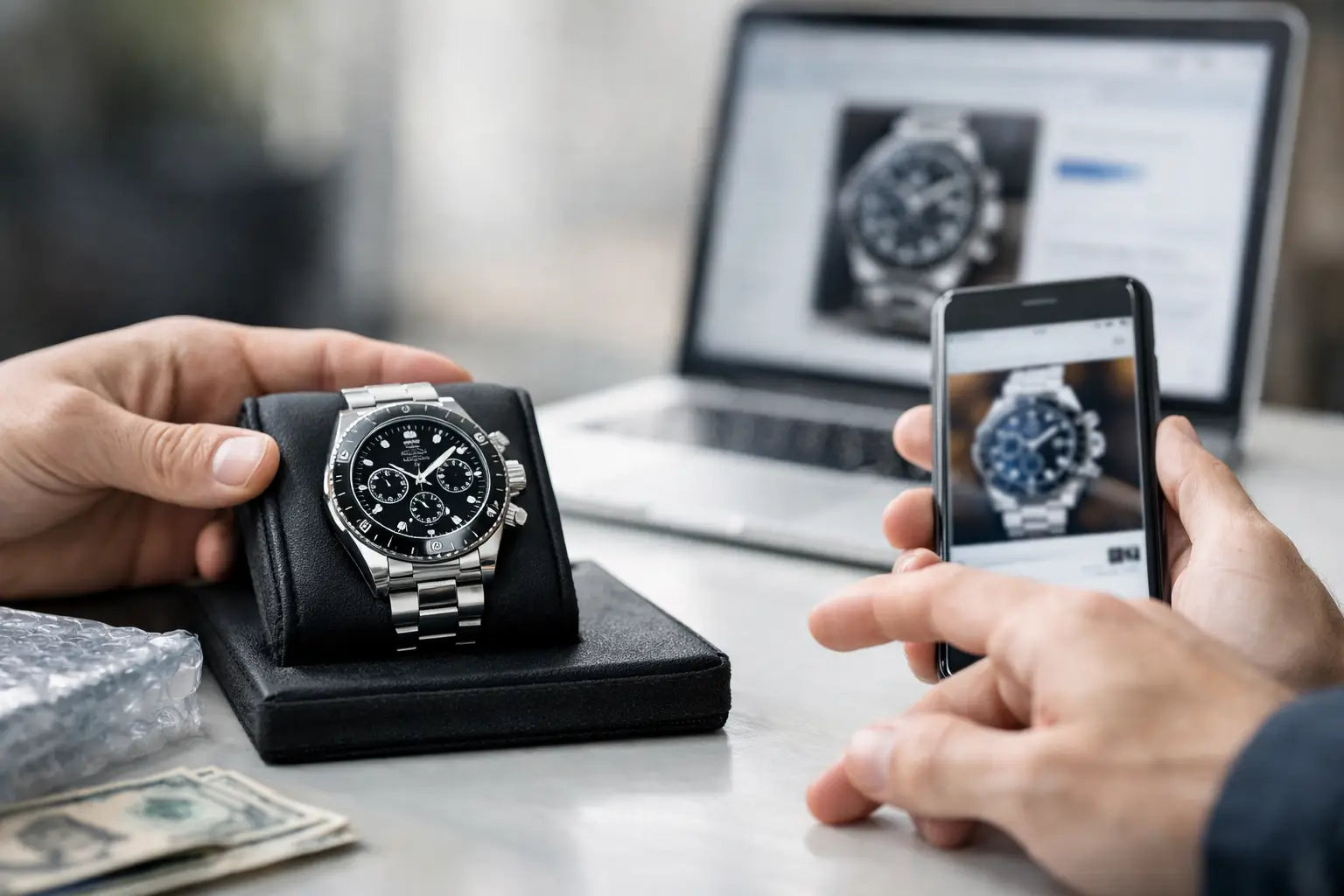
A £5,000 watch can become a costly mistake the moment you hand control to the wrong platform or buyer. If you want to sell luxury watch safely online, the real challenge is not simply finding interest. It is getting a fair price, protecting the watch in transit, and making sure payment lands without delays, chargebacks or arguments after the sale.
That is where many sellers come unstuck. Private marketplaces can look attractive at first glance, but fees, time wasters, low offers and buyer disputes often eat into the headline price. At the other end of the scale, some dealers move slowly or price too cautiously. The safest route is usually the one that combines specialist valuation, insured handling and clear payment terms from the start.
What it takes to sell luxury watch safely online
Safety, in this market, means more than posting a parcel with compensation. It means knowing who you are dealing with, understanding what your watch is worth, and using a process that protects both the watch and your money. A secure sale should cover four points: accurate valuation, verified buyer, insured transit and irreversible payment by bank transfer.
A proper valuation matters because unrealistic pricing creates risk. If you advertise a Rolex Submariner, Omega Speedmaster or Tudor Black Bay too high, the watch can sit unsold for weeks while the market moves under you. Too low, and you leave money on the table. Specialist buyers who actively purchase watches every day tend to give a more useful read on current market demand than general marketplaces, where asking prices are often confused with achieved prices.
The buyer matters just as much. A serious watch buyer should be easy to verify, clear about its process and willing to explain how funds are paid. If the only reassurance on offer is a vague promise and a mobile number, that is not enough for a valuable asset.
Why private selling often feels riskier than it looks
Many owners start with the obvious idea: list the watch yourself and hold out for the highest offer. Sometimes that works. More often, it brings a long thread of messages, requests for extra photos, offers well below market level and buyers who disappear as soon as you ask for proof of funds.
Even when a private buyer agrees a price, risk remains. Payment methods can be reversed. Collection meetings can be uncomfortable. Online platforms may favour the buyer if a dispute is raised over authenticity, condition or contents. That can leave the seller trying to prove what was sent and when.
There is also the issue of net return. A marketplace might show a strong sale price, but once selling fees, payment processing charges, insured delivery and negotiation are factored in, the amount you actually keep may be far less impressive. For sellers who want certainty, speed and a professional process, a direct specialist sale is often the better commercial decision.
How to prepare your watch before you sell
The strongest sales start with clean information, not polished sales talk. Gather the reference number, brand, model, year if known, service history and details of any replacement parts. If you still have the original box, warranty card, booklets, spare links or receipts, set them aside before requesting a valuation.
Condition should be described honestly. Light desk marks are normal. Overstating condition is where trouble starts. A buyer or specialist will inspect the watch anyway, and if expectations have been set badly, the price discussion becomes harder than it needs to be. Clear photographs of the dial, case, bracelet, clasp, caseback and movement if available will help speed up an appraisal.
Do not rush to have the watch polished or serviced before seeking an offer. That depends on the model and the market. On some vintage pieces, untouched condition can be more desirable than recent cosmetic work. On other watches, a fresh service may help. The sensible move is to ask first, not spend first.
Choosing the right buyer for a secure sale
If your priority is to sell luxury watch safely online, the buyer should be judged on process as much as price. A specialist buyer should be able to explain how the watch is valued, how it is insured in transit and when payment is made. Those are basic questions, not awkward ones.
Look for a business that buys across a broad range of brands and categories rather than only cherry-picking the easiest stock. That usually points to real market knowledge. High-demand names such as Rolex, Patek Philippe and Audemars Piguet are straightforward enough, but a capable buyer should also understand Omega, Cartier, Breitling, Grand Seiko, TAG Heuer, IWC, vintage pieces and niche enthusiast models.
A broad-market buyer is often more useful because sellers do not always have one obvious trophy watch. They may have an inherited collection, a mix of luxury and mainstream pieces, or a model with value that is less obvious to a general dealer. Knowledge reduces friction, and friction usually costs money.
Shipping, insurance and the part sellers worry about most
For many owners outside London, the greatest concern is simple: what happens once the watch leaves my hands? That concern is reasonable. A luxury watch should never be sent through an unstructured process with vague insurance terms.
A professional transaction should include fully insured postage or collection, clear packing instructions and a defined chain of custody. That means you know who is handling the parcel, what level of cover applies and what happens when it arrives. If a company is casual about this stage, treat that as a warning sign.
It also helps to keep records on your side. Photograph the watch before packing, photograph the accessories included, and keep copies of shipping confirmations. Good buyers already work carefully, but proper documentation gives you another layer of protection.
Payment should be fast, clear and final
The best online watch sales are the ones that do not leave you chasing money. Bank transfer remains the cleanest route for most UK sellers because it is direct, familiar and easier to verify than many alternative methods.
Before you agree a sale, ask when payment is released. Some buyers inspect first and pay the same day. Others may need up to 24 hours. That is not necessarily a problem as long as the timing is clearly stated in advance. What you want to avoid is uncertainty, especially if the watch has already been delivered.
Be cautious of any buyer pushing unusual payment arrangements, instalments or complicated third-party methods. High-value transactions work best when the structure is simple. Agreed offer, insured receipt, final inspection, instant bank transfer. The more moving parts there are, the more opportunities there are for delay or dispute.
Direct sale or consignment?
Not every seller has the same priority. Some want immediate liquidity and the least hassle possible. Others are willing to wait longer to try to maximise proceeds. That is where the distinction between direct purchase and consignment matters.
A direct sale suits owners who value speed, certainty and convenience. You receive an offer, complete the process and get paid quickly. There are no listings to manage, no buyer conversations and no waiting for someone to commit.
Consignment can make sense if the watch is especially desirable, unusual or likely to achieve more with patient marketing. The trade-off is time. You may get a stronger final result, but completion is not immediate and proceeds depend on the eventual sale. For many sellers, the right choice comes down to cash now versus potentially more later.
Common mistakes when trying to sell luxury watch safely online
The first mistake is chasing the highest headline number without asking how that number becomes cash in your account. A big asking price is not the same as a completed, dispute-free sale.
The second is dealing with buyers who are hard to verify. If the company, valuation process or payment method feels unclear, that is enough reason to pause.
The third is underestimating documentation. Box, papers, service records and spare links do not always transform the value, but they can materially affect buyer confidence and final pricing.
The fourth is assuming every watch should be sold in the same way. A current-production sports Rolex may have several strong options. A vintage Omega, inherited gold dress watch or niche independent piece may need a more specialist route.
The best online sale is the one you can complete with confidence
Selling a valuable watch should feel commercial, not stressful. You want a fair offer based on the live market, a buyer that knows the difference between a standard listing piece and a genuinely strong example, insured handling from door to door, and payment that arrives when promised.
That is why specialist buying services appeal to so many UK watch owners. They remove the weak points that make private selling frustrating: fees, delays, no-shows, risky payment methods and the possibility of buyer disputes after the watch has gone. Businesses such as Watch Nest are built around exactly that problem, giving sellers a direct route to valuation, insured transit and fast payment without the usual marketplace noise.
If you are selling a luxury watch, caution is not hesitation. It is good business. The right buyer will never ask you to trade safety for speed.